
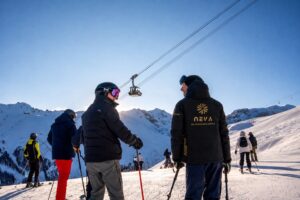
Val d’Isère is one of France’s most iconic ski resorts. Situated at an altitude of 1,850 metres in the village, rising to 3,456 metres at the Grande Motte glacier, and at the heart of the Espace Killy ski area shared with Tignes, it attracts skiers from all over the world every winter. For a ski school, teaching on this terrain is no ordinary service. It is a craft that is built up over time. Here is what six seasons at NEVA have taught us.
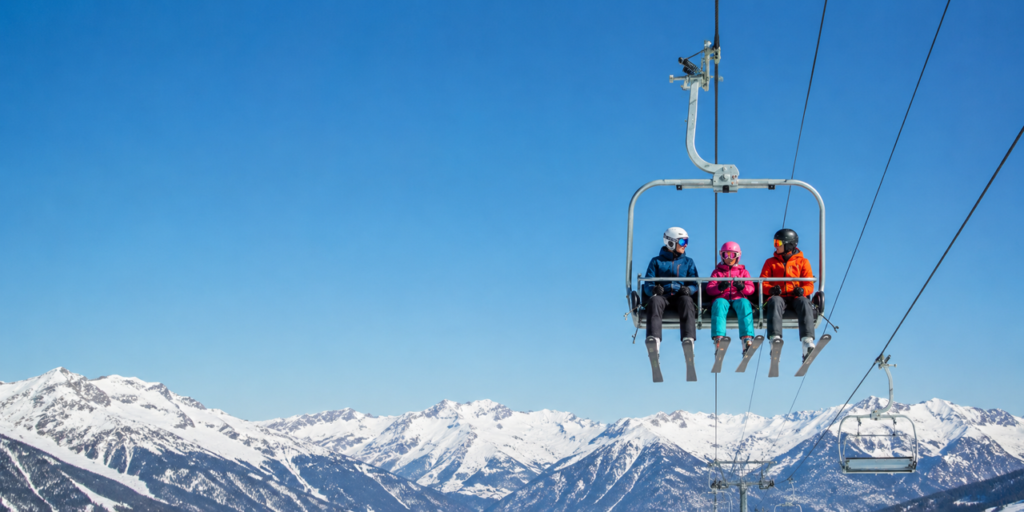
Val d’Isère, a special case in French skiing
Val d’Isère became a ski resort in 1934. Every year since 1955, it has hosted the Critérium de la Première Neige, a historic stage of the Alpine Ski World Cup, on the OK run at Bellevarde. The resort hosted the men’s alpine skiing events at the 1992 Albertville Olympic Games and organised the Alpine Skiing World Championships in 2009.
This sporting history is no mere footnote. It has shaped a skiing culture that is passed down through generations of skiers and between the resort’s ski schools. Jean-Claude Killy, born in Saint-Cloud on 30 August 1943, arrived in Val d’Isère at the age of three with his parents in 1946. He learnt to ski there, won his first Critérium in December 1961, and went on to win three gold medals at the 1968 Grenoble Olympic Games (downhill, slalom and giant slalom) .
The Val d’Isère–Tignes ski area now bears his name: the Espace Killy. In Val d’Isère, the history of skiing and the history of the resort are one and the same.
This heritage changes the very nature of learning to ski. When we teach here, we are teaching in the cradle of French skiing.
A high-altitude ski area that changes every month
The Espace Killy stretches from 1,550 metres at the base of the ski area (on the Tignes side) to 3,456 metres at the Grande Motte glacier. Around 60% of the ski area lies above 2,500 metres, making Val d’Isère one of the highest ski areas in the French Alps (source: Snow-Wise, the resort’s official guide). This altitude guarantees excellent snow cover from late November to early May, according to figures provided by the tourist office.
But a season in Val d’Isère isn’t a single, uniform block. Skiing in December is nothing like skiing in April. Right at the start of the season, the snow is cold and stable, the slopes are quiet – the ideal time to build up your technical skills. January marks the peak of the season with its perfectly groomed snow. February is the busiest time of year at the resort, when the instructor must know how to avoid overcrowded areas. March often brings the best snow of the winter, with late-season powder and already warm sunshine. April is spring at high altitude, with temperature fluctuations that radically transform the snow between 9 am and 2 pm.
This knowledge of the cycles cannot be learnt from a manual. It is built up by spending several full winters in the ski area. A good ski instructor in Val d’Isère knows, at 11 am in March, which slope will have the best snow. He knows which areas to avoid at the start of the season because the rocks are still exposed. They know where the light is beautiful in the late afternoon on Solaise. This information radically changes the quality of a day’s skiing.
This is one of the reasons why we retain our team over several seasons at NEVA. Skiers who return every year can be reunited with the instructor who helped them improve last year. This changes the very nature of the lesson.
The ski instructor qualification: what it actually guarantees
In France, the profession of ski instructor is regulated by a compulsory state qualification. The State Ski Qualification – National Alpine Ski Instructor (formerly BEES Alpine Skiing) is awarded by the National School of Skiing and Mountaineering (ENSA) based in Chamonix. The training lasts on average 4 to 7 years, with a statutory maximum of 10 years. It is listed in the National Register of Professional Certifications under number RNCP 38415, at level 5 (equivalent to two years of further education).
The technical entrance test, formerly known as the Eurotest, is a giant slalom event requiring a time of less than or equal to a certain percentage of the reference time (approximately 19% for men, 25% for women). Refresher training is mandatory every 6 years to keep the qualification up to date.
According to ENSA and several specialist sources, the French diploma is one of the most demanding in the world, which opens up the possibility for its holders to teach abroad without additional training in the majority of countries.
At NEVA, our instructors have the technical and teaching skills required to support each student’s progress. Some are still completing their training and work within the applicable regulatory framework. Beyond initial training, expertise is developed through practical experience, familiarity with returning students and ongoing professional development.
Why a small-scale approach makes all the difference
In Val d’Isère, every skier can choose guidance suited to their level, goals and preferred way of learning. NEVA takes a personal, human-scale approach, with small groups, an experienced team of instructors and individualised support. This structure allows us to provide more attentive and flexible tuition, focused on each skier’s progress.
This choice for a more personal approach has tangible consequences for the quality of learning. We limit our groups to a maximum of 6 pupils. In a group of this size, the instructor gets to know each pupil within minutes, identifies any difficulties and adjusts the pace accordingly. In a larger group, this is simply impossible. You have to aim for the average level and accept that some pupils will fall behind.
This approach is reflected in our various ski lesson formats. Small-group lessons for children and teenagers, private or one-to-one lessons for those seeking exclusive attention, and all-inclusive packages for hassle-free holidays. Each format serves a specific purpose, but all share the same philosophy. No overcrowding. No standardisation. An instructor who adapts.
What skiers really look for in a ski school
After six seasons of observation and discussions with our students, here are the most common expectations we’ve heard.
Consistency with the same instructor from one year to the next. Many families want to have the same instructor again, either because a bond of trust has developed with their child or because the child’s progress has been tangible. A school that retains its team can offer this consistency.
The ability to adapt the lesson to the day’s conditions. The weather at altitude is unpredictable. A lesson scheduled for a Tuesday morning may need to be rescheduled mid-morning. A good instructor knows how to adapt a session without compromising it.
A genuine focus on personal goals. An adult starting at 40, a parent wanting to regain their level from ten years ago, or a teenager wanting to improve in the snowpark are not looking for the same thing. The instructor must pick this up quickly and adapt their teaching approach.
Supportive guidance. Skiing is a sport where fear plays a significant role, particularly among adult beginners. A lesson that ignores this emotional aspect can hinder progress. A lesson that takes it into account helps to overcome it.
A French ski school in Val d’Isère today
Val d’Isère is a French resort but also an international destination. Guests come from London, Brussels, Geneva, New York, Moscow and Hong Kong. This diversity changes the role of a local ski school.
It must be able to welcome and teach an international clientele in several languages, depending on each instructor’s individual skills. This openness goes beyond communication: it also requires an understanding of different skiing cultures. Attitudes towards risk, performance, progression and learning can vary depending on each person’s background and experience. A good instructor knows how to adapt their guidance while maintaining a clear, consistent and demanding teaching approach.
This adaptability is, in our view, what sets a ski school in Val d’Isère apart. The technical mastery required by the state diploma, combined with a detailed understanding of a high-altitude ski area that changes every month, plus the human sensitivity needed to teach a very diverse range of people. Three distinct skills that are developed over time.
This is the DNA of our NEVA school, at the foot of the slopes, 26 Place des Dolomites. We have been living this for six seasons. We have been championing this for six seasons.
Val d’Isère in figures
- 1,850 m: altitude of the village of Val d’Isère
- 3,456 m: highest point in the ski area (Grande Motte glacier)
- 300 km: length of the Espace Killy ski area, shared with Tignes
- 1934: the year Val d’Isère became a ski resort
- 1955: first edition of the Critérium de la 1ère Neige
- 1968: Jean-Claude Killy won three Olympic gold medals in Grenoble
- 4 to 7 years: average duration of training for the State Ski Diploma
- 6: maximum number of pupils in a NEVA group lesson
- 6: number of seasons NEVA has spent in Val d’Isère
Sources and references
- Val d’Isère Official Tourist Office, valdisere.com
- Compagnie des Alpes, official resort data
- National School of Skiing and Mountaineering (ENSA), State Diploma training
- National School of Mountain Sports (ENSM), official website
- RNCP 38415, France Compétences
- Wikipedia (Jean-Claude Killy, Alpine ski instructor, BEES alpine skiing course)
- Onisep, State Diploma in Skiing job description
- Snow-wise, independent guide to Val d’Isère
- Encyclopédie Universalis, biography of Jean-Claude Killy